
Caswell County Projected Release Dates
NCDAC Offender Public Information uses the exact label Projected Release Date. It is a sentence-computation estimate for a state prisoner. The same individual record may show Actual Release Date, Last Movement, sentence status, minimum and maximum terms, and probation, parole, or post-release dates. Those fields must be read together. The estimate does not promise release at a certain hour or show by itself whether the destination is Caswell County.
Caswell County Detention Center holds pretrial detainees as well as people serving local sentences. A pretrial person has no sentence-based projected date. Release may depend on bond, a court order, dismissal, or another case event. A person serving a county sentence may have an existing computation held by the Sheriff or court, but no public Caswell County release-date calculator was verified.
- Projected release date
- A current estimate produced from the sentence and applicable credits or rules.
- Actual release date
- The recorded date the named custodian ended confinement.
- Jail credit
- Eligible time already spent in custody that is applied to the sentence.
- Detainer
- A hold or request from another authority that can affect the release path.
Find Caswell County Release Dates
The search path starts with custody type. Caswell Correctional Center and Dan River Prison Work Farm are NCDAC prisons, so state records apply to people confined there. Caswell County Detention Center is a county jail, and the Sheriff's record applies to its booking episodes. Physical location inside Caswell County does not turn a prison record into a county jail record.
- Decide whether the person is a pretrial detainee, a local sentenced inmate, or an NCDAC state prisoner.
- For NCDAC custody, open Offender Public Information and search by offender number or matched identity.
- Open the correct record. Read Most Recent Incarceration Summary, Projected Release Date, current location, incarceration status, and detainer flags.
- Review sentence rows, minimum and maximum terms, sentence status, and Last Movement. Do not rely on an isolated historical row.
- For a county sentence, ask the Sheriff or Caswell Clerk for the judgment, jail credit, and existing computation or release entry.
- For a pretrial case, read the bond or court order and ask the jail whether physical custody has ended.
- After release, replace the estimate with Actual Release Date, Last Movement, and any active supervision status.
The NCDAC Inmate Release Search serves a different task. It can filter state-prison releases by release county, year, and month, with CASWELL as county code 17. It is not a list of people discharged from the Caswell County Detention Center and does not replace the individual record when a future estimate is needed.
The county and state pathways are also separated in the Caswell County release search, including the route for a durable booking and release record.
Note: A state prison located in Caswell County may release someone to another county, so confirm the destination separately.
Caswell County OPI Release Fields
OPI offers more than a single date. The search record can show identity and aliases, offender number, incarceration status, total term, conviction date, primary crime, admission date, current and past locations, Last Movement, detainer and escape flags, sentence history, and supervision history. That breadth is useful because a projected date can appear beside an old sentence even when a later custody episode controls the person's current status.
| OPI field | How to read it |
|---|---|
| Projected Release Date | The current sentence-computation estimate, not a guaranteed release event. |
| Actual Release Date | The recorded end of a state custody episode after the event occurs. |
| Incarceration status | Shows whether the state confinement record is active or inactive. |
| Last Movement and date | Helps distinguish release from transfer or another institutional move. |
| Minimum and maximum term | Shows the court-imposed range used in structured-sentence computation. |
| Detainer flag | Signals that another authority may affect where the person goes next. |
| Supervision status and dates | Shows whether confinement ended into parole, probation, or post-release supervision. |
An Inactive label alone is not sufficient. It can describe a closed historical record while another episode exists. A stronger public conclusion combines incarceration status, Actual Release Date, Last Movement, sentence status, and any active supervision entry. If those fields conflict, the agency record should be clarified before a release is treated as final.
The main OPI search can be narrowed by status, last and first name, middle initial, offender number, date of birth, age range, and other identity fields. Use the offender number when available. Otherwise, treat Soundex and broad birth-year choices as discovery tools, then compare the selected record's identity and sentence details before relying on its projected date.
Summary and sentence-level dates can differ for valid reasons. A historical sentence row may remain after another custody episode begins, and a later movement may control current status. Record the field label, the custody episode, and the access date instead of copying a date without its context.
North Carolina Earned Release Time
Structured Sentencing ended ordinary parole for offenses committed on or after October 1, 1994. The North Carolina Commission explains that a structured-sentencing offender must serve at least 100 percent of the minimum and 85 percent of the maximum. After the required prison term, felony offenders generally enter post-release supervision. This is why a projected date can precede the maximum term while never falling below the minimum.
The phrase “serve 85 percent” is incomplete when used alone. G.S. 15A-1340.13(d) states that the minimum term must be served and that earned time may reduce the maximum, but not below the minimum. G.S. 148-13 authorizes DAC rules for custody grades and gain or earned time. Article 84A governs release dates and post-release supervision.
The minimum and maximum terms selected in the judgment, jail credit, concurrent or consecutive sentences, earned-time awards or losses, disciplinary events, legal corrections, detainers, and later court action all feed into the result. An independent calculation made by multiplying the sentence by 85 percent can miss several of those inputs. OPI's current estimate is the appropriate public field.
The governing minimum-term statute appears in the official North Carolina law source.
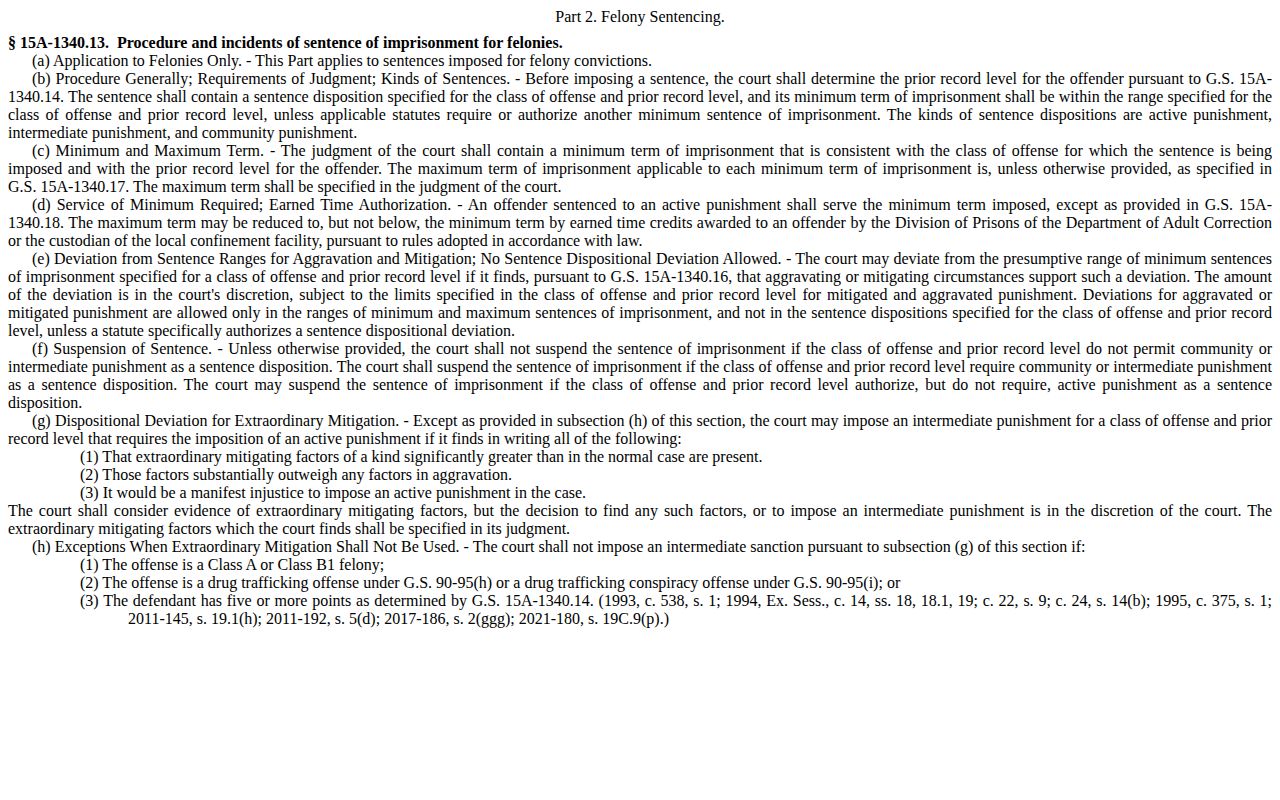
The statute explains why earned time can reduce the maximum side of a sentence without erasing the court-selected minimum.
Why Caswell County Release Dates Change
A projected date changes when an input to the official computation changes. Some changes come from conduct and earned-time rules. Others come from the sentence, court, or a separate custodian. The direction is not always later. A correction to jail credit or sentence structure can also move the estimate earlier when the official record supports it.
| Factor | Possible effect | Where to confirm |
|---|---|---|
| Earned-time award or loss | Changes reduction of the maximum term but cannot cut below the minimum. | NCDAC computation and current OPI date. |
| Disciplinary event | Can affect credit or custody grade and move the estimate. | NCDAC records, not an outside calculation. |
| Jail credit correction | May change the amount of prior custody applied to the term. | Judgment, clerk record, and NCDAC computation. |
| Concurrent or consecutive terms | Changes how multiple sentences run together or in sequence. | Sentence rows and court judgment. |
| Detainer or hold | May prevent community release or send the person to another custodian. | OPI flag and the responsible agencies. |
| Later court action | Can correct, modify, or otherwise affect the legal term. | Caswell Clerk and updated NCDAC record. |
| Parole decision | Relevant mainly to eligible older-law cases and limited exceptions. | Commission sources and OPI status. |
A transfer is not a new release date. Last Movement may show that a person left one Caswell facility while remaining in state custody. Likewise, release from state prison into post-release supervision ends confinement but begins a community-supervision term. Each transition should be named precisely.
Note: A detainer can change the release destination even when the original Caswell County sentence has reached its endpoint.
Caswell County Jail Date Limits
No Caswell-specific county good-time policy was verified. No official weekend-release statute or local practice was found that automatically moves a Sunday date to Friday or Monday. Those claims should not be inferred from practices in another jail. For a local sentence, ask the Sheriff or Clerk for the existing computation, judgment, jail credit, and release entry.
The Caswell County Detention Center also states that it does not set bonds, change court dates, decide verdicts, or determine punishment. A bond-out date is controlled by judicial action plus the jail's processing of the order. The court record can show when release became authorized, while the Sheriff's record is the stronger source for when physical custody ended.
A pretrial detainee is the clearest example of why no date should be invented. The next event depends on bond, a judge's order, case disposition, transfer, or other legal action. Calling that a “projected release date” would falsely make a case-dependent event look like a sentence calculation.
When a county-sentence date is needed, request an existing record rather than asking the agency to create a new calculation. North Carolina public-record law does not require an office to compile a record that does not exist. A focused request for the judgment, recorded jail credit, current computation, and later release entry keeps the request tied to documents the Sheriff or Clerk may already hold.
Confirm Caswell County Actual Release
A future estimate should be watched, then replaced with an actual record. For NCDAC, compare Projected Release Date with Actual Release Date, Last Movement, incarceration status, location, and supervision after the event. For the county jail, ask whether the booking ended, whether it ended in community release or transfer, and what date and time the Sheriff's release entry records.
NC SAVAN can send a custody-change alert for North Carolina jails and Adult Correction. Registration uses the correct person record and can deliver phone, text, or email notice. A transfer can trigger the alert, so the receiving custodian must still be confirmed. Detailed registration and re-registration steps appear in the Caswell County VINELink inmate search.
Final proof depends on the system. County release records establish the local booking endpoint. OPI establishes state-prison movement, actual release, and supervision. A court judgment explains the legal sentence but may not show the jail-door time. Keeping those records separate prevents a projected date, a court order, and a completed physical release from being treated as the same event.