
Caswell County Parole and Probation
North Carolina uses three forms of community supervision that are easy to confuse. Probation comes from a court order and commonly serves as an alternative to active imprisonment. Parole is a discretionary prison release for people eligible under older law and a narrow set of exceptions. Post-release supervision, often shortened to PRS, follows a state-prison term under current structured-sentencing law. The NCDAC Division of Community Supervision oversees each type in the community.
A person can be released from Caswell County custody and still have a live state record. Someone leaving the Caswell County Detention Center on bond may have no DAC supervision record at all. Someone leaving Caswell Correctional Center or Dan River Prison Work Farm may move directly to post-release supervision. The custody source must be identified before the status is interpreted.
| Supervision type | How it begins | What to verify |
|---|---|---|
| Probation | A court imposes community supervision, often without an active prison term. | Active probation status, assigned office, and the court case. |
| Parole | The Parole Commission authorizes release for an eligible older-law case or exception. | Parole status, begin and end dates, and Commission action where public. |
| Post-release supervision | A qualifying state-prison term ends and mandatory community supervision starts. | PRS status, actual release date, current office, and supervision dates. |
- Discharge
- The formal end of custody or supervision, not merely a move between offices.
- Absconder
- A supervised person who fails to maintain contact and actively makes their location unknown.
- Detainer
- A request or hold from another authority that can affect custody or release.
Check Caswell County Supervision Status
The official starting point is NCDAC Offender Public Information, called OPI. It covers prison records, probation, parole, post-release supervision, releases, and historical information. It does not contain ordinary Caswell County jail bookings. Search with the status set to All when the person might have left prison but still be supervised. Active Probationer-Parolee is useful when active community supervision is already expected.
- Use the DAC offender number when known. Otherwise enter the last and first name, then narrow similar matches with age or birth information.
- Open the offender-number link only after matching more than one identifier. A county booking number and a DAC offender number are separate identifiers.
- Read incarceration status and Last Movement with Actual Release Date. These fields establish whether state confinement ended.
- Check probation, parole, and post-release status. Note the listed Probation/Parole Office and the supervision begin and end dates.
- If the office field is missing or unclear, use the official Community Supervision directory or call headquarters for routing.
- Confirm any claimed warrant with the clerk or law enforcement. OPI absconder status alone does not prove that a warrant is active.
For a county-only release, first use the Sheriff record route described on the Caswell County released inmate search. OPI becomes relevant if the person entered state custody or state supervision. A live jail list, by contrast, only helps with present physical custody and often drops a person after release.
Note: Read the entire OPI record because an inactive historical episode can coexist with a later active case.
Caswell County Supervision Office Route
NCDAC says Community Supervision has offices in every county, but the research did not yield a stable Caswell office address or direct telephone number from the current field roster. That gap should not be filled with a guessed contact. The person's OPI record is the best local routing source because it can name the assigned Probation/Parole Office. If the field is incomplete, the statewide headquarters can identify the proper office.
North Carolina Community Supervision
2020 Yonkers Road, MSC 4250
Raleigh, NC 27699-4250
Phone: 919-716-3100
Community Supervision office directory
The North Carolina Post-Release Supervision and Parole Commission is a different body. It makes parole and post-release decisions, while Community Supervision carries out field supervision. The Commission is not the routine contact for reporting instructions or a person's assigned officer.
The official directory is illustrated by the NCDAC local-office source.
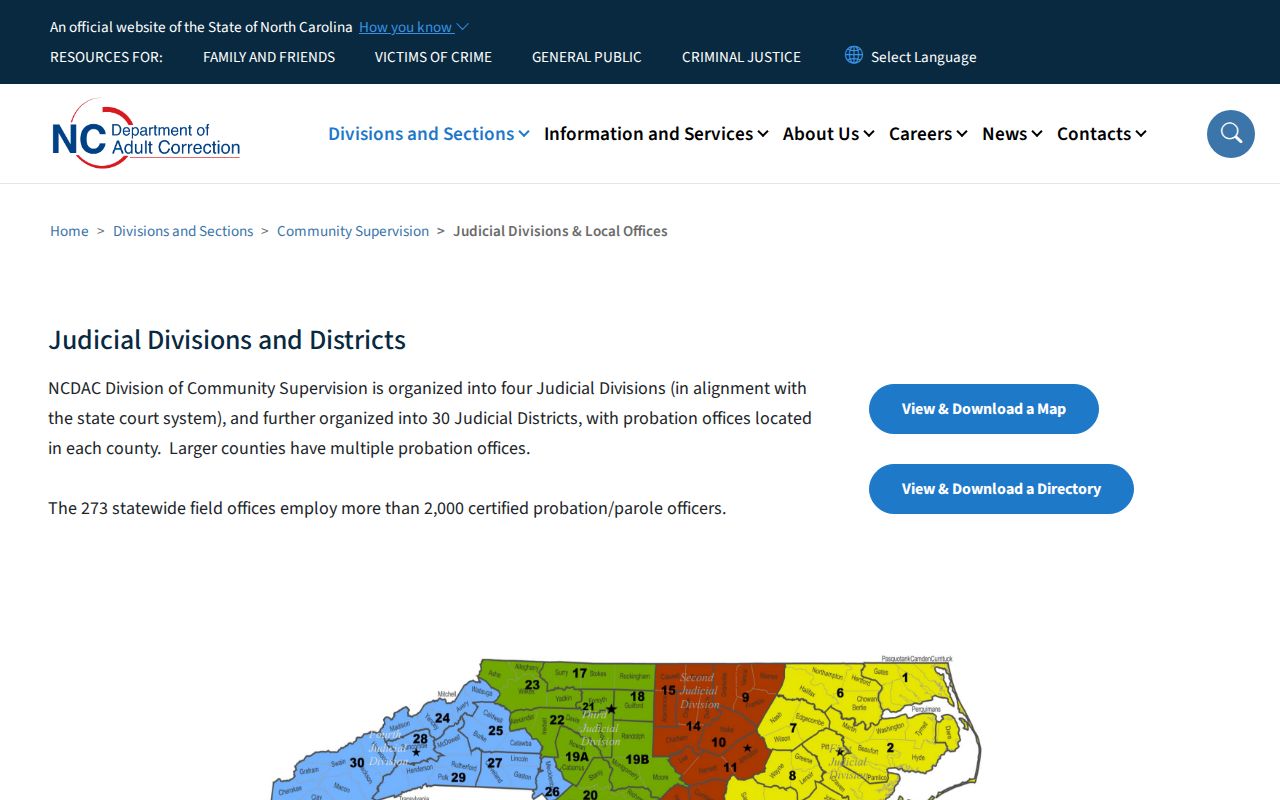
The directory is a routing aid; the office shown on the person's OPI record remains the stronger person-specific lead.
Caswell County Absconder Records
An absconder has not lawfully completed supervision. NCDAC defines the term as a person who fails to keep contact and actively avoids supervision by making their whereabouts unknown. The separate NCDAC absconder search can be checked after the main OPI record. It should be used as a status check, not as a substitute for an officer, clerk, or law-enforcement confirmation.
Several limits matter. Removal from the list may lag after a death. Some people shown as absconders may be confined outside North Carolina or outside the country. An absconder entry also does not identify every violation, prove a new conviction, or state by itself that a court warrant exists. The NCDAC tip line is 1-888-646-0024 and accepts anonymous tips.
Detailed supervision files are generally confidential under G.S. 15-207. Public OPI fields can show status and office, but they do not open the officer's complete case file. This line protects the difference between public navigation data and confidential supervision work.
Note: Treat absconder status as an unresolved supervision condition, then verify any warrant through the proper public office.
Caswell County Parole Review Records
North Carolina does not use a conventional public parole-hearing calendar. The Commission says it does not hold formal hearings and does not meet personally with offenders during possible-parole review. The correct recurring source is its monthly Discretionary Parole Reviews page. Those reports summarize action types, but there is no verified full person-by-person decisions search beyond OPI history and the published monthly material.
Possible report outcomes include Incomplete Decision, Suspend Decision, Regular Parole, Community Service Parole, Early Medical Release, 90-Day Mandatory Parole, and Denial. An incomplete decision means the Commission needs more information, an evaluation, or investigation. A suspended decision pauses consideration or ends a violated arrangement. Neither label should be reported as a release.
Ordinary parole was abolished for offenses committed on or after October 1, 1994 under Structured Sentencing. Eligibility now centers on earlier offenses and limited exceptions. G.S. 15A-1371 governs major older-law eligibility, release, and denial rules. For current state-prison terms, post-release supervision is usually the relevant category instead.
Caswell County Reentry After Release
No dedicated Caswell Local Reentry Council was verified on NCDAC's current list. That absence matters because a released person should not be promised a local council program that may not exist. NCDAC Community Programs describes services for people under community supervision through referral by an assigned officer. The practical route is to ask that officer about available programs and eligibility.
Caswell Correctional Center and Dan River Prison Work Farm have institutional vocational or work programs, but those programs are not public release locators. Participation also does not identify the current supervising office. After a state-prison release, OPI status and the assigned officer remain the correct route for supervision facts. A person released only from the county detention center may have court obligations without any DAC supervision at all.
Note: Community program access depends on officer referral, so confirm the assigned Caswell County supervision office before seeking a service.
When Caswell County Supervision Ends
Release from a facility and discharge from supervision are separate events. A state prisoner may have an Actual Release Date and then an active post-release term. A probationer may never have served a state-prison term. Completion is best shown by an inactive or ended supervision status, the recorded supervision end date, and any available court or agency discharge record.
NC SAVAN can provide custody or supervision change alerts because North Carolina links its jails and Adult Correction systems. It does not supply parole-review notices, and a transfer alert does not equal community release. For a durable answer, compare the OPI status with the originating court or supervising agency. Do not rely on a person's absence from a jail roster or a single automated notice.
Conditions and violations vary by case and are not fully public. A supervising officer can explain reporting instructions to the supervised person. A court record can show a judicial response. Public records should be read at the correct level: status for the public, person-specific instructions from the responsible office, and formal discharge only when the record supports it.
Identity matching remains important at discharge. OPI permits searches by offender number, name, Soundex, date of birth, and age range, but broad search tools are aids rather than proof. Compare the offender number and at least one more available identifier before tying an end date to a person. Then make sure the end date belongs to the current supervision episode rather than an older sentence row.
For a Caswell County court case, the eCourts docket or Clerk can help explain a probation judgment or later court action. That legal record does not replace the state supervision status. In the other direction, an OPI end date may not display the full court reasoning. Using both sources keeps the order, supervision period, and final status in their proper roles.